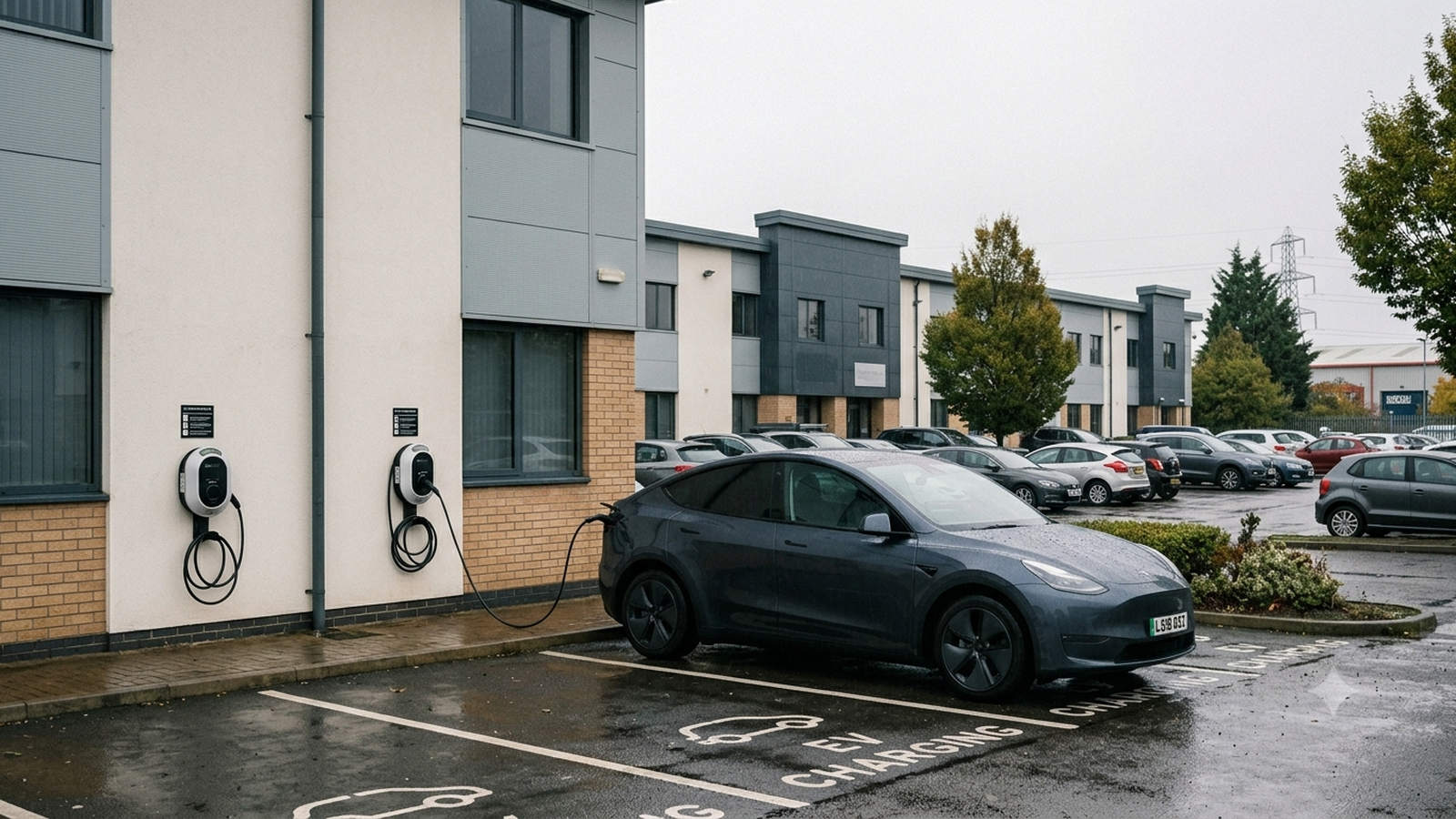
 FIG. 01 / HERO PHOTOGRAPHY — WORKPLACE CHARGING, OFFICE STAFF CAR PARK
 If you run a workplace and you have been putting off installing EV charging, the maths got better on 1 April 2026. The Workplace Charging Scheme, the main government grant for businesses, rose from £350 to £500 per socket the same week two other schemes that businesses and landlords leaned on closed to new applications. The grant has been extended for one final year and then it stops. So this is a guide to what you can actually claim in 2026, who qualifies, what it costs after the funding, and the bit most pages skip: how charging at work is treated for tax.
The honest framing first. Workplace charging is not free money, and it is not the right call for every site. But for an employer with off-street staff parking, the current grant is the most generous the scheme has been, and it has a hard deadline. Get the timing right and the government covers a meaningful chunk of the bill. Get it wrong, or chase the wrong scheme, and you either overpay or apply for funding that no longer exists.
What workplace charging is and why employers offer it
Workplace charging means EV chargepoints installed at a place of work for staff, company-car and fleet drivers, or visitors to use. Most installations are 7kW or 22kW AC units in a staff car park, the same broad technology as a home charger but in commercial-grade housing and, usually, in greater numbers.
Employers do it for a handful of practical reasons rather than for show. It is a genuine staff perk that helps recruitment and retention, particularly for employees who rent, live in flats, or have no driveway and therefore cannot charge cheaply at home. It makes a company-car or salary-sacrifice scheme far more attractive, because an employee who can top up at work is much more likely to take an electric car in the first place. It keeps a fleet of electric vans or pool cars moving. And for some businesses it supports visitor or customer charging and wider sustainability commitments. That is the on-ramp. The part that actually shapes the decision is the grant, the cost, and the tax treatment, so the rest of this guide is about those.
The Workplace Charging Scheme: what you can claim in 2026
The Workplace Charging Scheme, or WCS, is the OZEV-administered grant that covers part of the cost of buying and installing chargepoints at a workplace. As of 2026 it works like this: the grant covers up to 75% of the combined purchase and installation cost, including VAT, capped at £500 per socket, for up to 40 sockets across all of an applicant’s sites. The 75% and the £500 cap work together, so on a cheaper install the percentage bites and on a dearer one the per-socket cap does. Whichever is lower is what you get.
Two dates matter. The per-socket rate rose from £350 to £500 on 1 April 2026, and it applies to installations completed on or after that date regardless of when you applied. And the scheme has been extended for a final year only, closing to new applications on 31 March 2027. After that, the main workplace grant is gone. The recency cuts both ways for anyone researching this: a lot of guidance still quotes the old £350 figure or points at schemes that have since closed, so check the date on anything you read, including this.
The process is a voucher system, and the order matters. You apply through the gov.uk grant application service and, if eligible, receive a voucher code. You then choose an OZEV-authorised installer, an authorisation that is specific to this scheme and not something every electrician holds, and give them the code. The installer checks the code, does the work, deducts the grant from your invoice, and claims it back from OZEV. The work has to be completed and the voucher claimed within 180 days of it being issued. You cannot install first and claim afterwards, and you cannot use an unauthorised installer and expect the grant.
- Grant rate
- Up to £500 per socket
- Covers
- 75% of purchase + install (inc VAT)
- Socket cap
- 40 sockets across all sites
- Scheme status
- Final year — closes 31 March 2027
- Voucher
- Valid 180 days
- Installer
- OZEV-authorised required
The grant is the most generous the workplace scheme has ever been, and it has a date on it. After 31 March 2027 the main workplace route closes.
Who qualifies, and who doesn’t
The WCS is open to a fairly wide field: businesses, charities, public authorities, and small accommodation businesses such as B&Bs and small hotels. The common requirement that catches people out is the parking. You need off-street parking that is genuinely for staff or fleet use, on-site or a reasonable distance from the workplace, not parking that exists only for customers. No off-street staff parking, no grant.
A few specific cases are worth being honest about, because this is where applications fail.
If your business is registered at your home address but the work actually happens elsewhere, or you are a sole trader working from home, a residential driveway is not automatically a workplace for grant purposes. The scheme is for charging at a place of work with qualifying staff or fleet parking, and a registered office that is really a house does not clear that bar on its own. Treat it as a case-by-case question rather than an assumption.
If your staff work from home and your premises has no real staff parking to electrify, the WCS is not the mechanism you are looking for. The grant funds infrastructure at a workplace, not a distributed set of home setups. There is one genuine exception covered below, where an employer funds a charger at an employee’s home for a company vehicle.
And state-funded education institutions, schools, colleges and nurseries, have their own separate scheme with a higher per-socket cap, currently up to £2,000 per socket for new applications. If you are an eligible education provider, apply through that scheme rather than the standard WCS. We have linked the gov.uk page for it rather than detailing it here, because the rules differ.
Use the checker to see where you land, including the cases where you think you qualify but do not.
With qualifying off-street staff or fleet parking you can claim up to £500 per socket — 75% of the purchase and installation cost (inc VAT), up to 40 sockets across all your sites. Apply for the voucher on gov.uk before work begins, then use an OZEV-authorised installer.
What it actually costs after the grant
Workplace charging costs are site-specific, so anyone quoting a single average is guessing. What is reliable is the shape of the cost and what drives it.
For a straightforward installation, a single 7kW AC socket in a staff car park typically lands somewhere in the region of £800 to £1,500 installed before any grant, broadly comparable to a home charger but in commercial housing. The £500 per-socket grant takes a real bite out of that. Step up to 22kW AC units and the per-charger figure rises. Move to DC rapid charging and you are into a different order of cost entirely, which is why most workplaces sensibly stick with AC fast charging for staff who park all day.
The variables that move the number are predictable. How many sockets you fit, because groundworks and cabling can be shared across several. The charger speed, AC versus DC. Your site’s existing electrical supply, which is the big one: a site without spare capacity may need a distribution board upgrade or a Distribution Network Operator supply increase, and that can run to several thousand pounds before a single charger goes in. Groundworks and trenching across a car park. And load management, the smart hardware that shares available power across active chargers so twenty 7kW units do not try to pull 140kW at once. For anything beyond five or six bays, load management is close to essential, and it is part of the budget rather than an optional extra.
The practical takeaway: a small staff install of a few AC sockets is an affordable, grant-supported project for most employers. A larger multi-bay rollout is a proper infrastructure job where the grant helps but the supply and groundworks decide the real cost, and a site survey is the only way to get a true figure. We are deliberately not going to quote a headline “commercial install” number, because at that scale there isn’t an honest one. The day-to-day electricity is its own line: our running costs hub covers what charging an EV actually costs to run.
The tax side: is EV charging at work a benefit?
This is the part most workplace-charging pages skip, and it is where the JustWatt-shaped detail lives. The short version: charging at work is, in most normal cases, not a taxable benefit for the employee. But the conditions matter, so here is the accurate picture.
Where an employer provides charging facilities at or near the workplace for an employee to charge their own electric car, there is no taxable benefit in kind on that electricity. This has been the case since 6 April 2018 under a specific exemption in the tax legislation. The conditions are that the charging is at or near the workplace rather than at the employee’s home, and that it is available to employees generally, or to all employees at a particular location, rather than handed to a chosen few. There is one important carve-out: if the workplace charging is bundled into a salary-sacrifice or other optional remuneration arrangement, the exemption falls away and it becomes taxable. So provide the charging as a straightforward facility, not as something employees sacrifice salary for, and the exemption holds.
For a company car, it is simpler still. Electricity an employer provides to charge a company car at the workplace is exempt, so there is no separate benefit-in-kind charge for charging a company EV at work. This sits alongside the broader reason electric company cars are attractive in the first place: the benefit-in-kind rate on a fully electric company car is far lower than on a petrol or diesel equivalent, which is what makes both company EVs and salary-sacrifice schemes work. The exact rate changes each tax year, so rather than quote a figure that drifts, our company-car tax calculator gives you the current number for a specific car, and our guide to the best salary-sacrifice providers covers how the scheme fits together. Workplace charging and salary sacrifice reinforce each other: staff who can charge at work are markedly more likely to take an EV through a scheme.
Charging a company car at an employee’s home
One useful wrinkle for employers with company-car drivers who genuinely cannot charge at work. The Workplace Charging Scheme can be used to fund a chargepoint installed at an employee’s home for a company vehicle, provided the chargepoint is approved for both residential and commercial use. It is the exception to the “workplace, not home” rule, and it exists precisely for the driver who has a company EV but no realistic way to charge it at the office.
The running cost follows sensibly too. Where an employer reimburses an employee for the electricity used to charge a company car at home, that reimbursement is exempt and does not create a taxable benefit, as long as it can be shown the electricity was solely for the company car. A smart charger that logs exactly how much energy went into the vehicle makes that straightforward to evidence. For the employee’s own private car, by contrast, the exemption does not stretch to reimbursing home or public charging, so keep the two cases separate.
How to get it done
The sequence for an employer is short and worth doing in order. Start by assessing the site: how much off-street staff or fleet parking you have, where the chargers would sit, and whether your electrical supply has the headroom or will need an upgrade. That assessment usually means a site survey, and it is the step that tells you whether this is a simple job or a supply-upgrade job.
Then choose an OZEV-authorised installer, because only an authorised installer can claim the grant. Apply for the WCS voucher through gov.uk before the work begins, give the installer the code, and let them complete the installation and claim the grant within the 180-day window. When you are talking to installers, the questions worth asking are practical ones: whether they are OZEV-authorised for this scheme, whether your supply needs upgrading and at what cost, whether load management is included for a multi-bay site, what the charge-point management and ongoing billing looks like, and whether it is worth running ducting to future charger positions now to avoid digging the car park up twice. If you are weighing the charger types themselves, our guide to EV charger types covers the AC-versus-DC choice, our best chargers guide covers specific units, and the wider chargers hub links the rest.
A note on boundaries, because the schemes are easy to confuse. The WCS is the workplace grant. If you are a homeowner or renter looking at charging at your own house, that is a different set of schemes entirely, covered on our home chargepoint grants page, and you should not apply for the WCS for a domestic install. For how public charging costs compare when staff are out on the road, our public charging guide sets out the pay-as-you-go rates, and the installation guide covers the practical side of getting chargers fitted.
How we put this together
This guide draws on gov.uk and OZEV grant guidance, HMRC’s employment income manual on workplace and company-car charging, and current industry pricing for workplace installations. The grant figures, the rates, caps, dates and eligibility, are taken from the live gov.uk pages and are cited below with the dates we checked them. We have no hands-on experience installing commercial charging and do not imply any; where we describe installation costs and practicalities we are synthesising published installer pricing and the regulations, not our own fieldwork. Grant terms changed on 1 April 2026 and the scheme closes on 31 March 2027, so we re-verify this page whenever OZEV updates its guidance.
Frequently asked.
How much is the Workplace Charging Scheme grant now?
From 1 April 2026 the WCS covers up to £500 per socket, up from £350, capped at 75% of the total purchase and installation cost including VAT, for up to 40 sockets across all your sites. It applies to installations completed on or after that date. The scheme has been extended for a final year and closes to new applications on 31 March 2027.
Who is eligible for workplace EV charging grants?
Businesses, charities, public authorities and small accommodation businesses can apply, provided the site has off-street parking genuinely for staff or fleet use rather than customers. You must use an OZEV-authorised installer and apply for the voucher before work begins. State-funded schools and colleges have a separate scheme with a higher per-socket cap.
Can a home-based business claim the Workplace Charging Scheme?
Not automatically. A business registered at a home address, or a sole trader working from home, does not necessarily have a qualifying workplace with staff or fleet parking, which is what the grant funds. It is a case-by-case question. If you are really after charging at your own home, the residential chargepoint grants are the right route instead.
Which workplace charging grants have closed?
Two schemes businesses and landlords used closed to new applications on 31 March 2026: the EV infrastructure grant for staff and fleets, and the commercial landlord chargepoint grant. Do not apply for these. The Workplace Charging Scheme remains open until 31 March 2027 and is the main route for workplace installations.
Is EV charging at work a taxable benefit for employees?
Usually no. Since April 2018, providing charging facilities at or near the workplace for an employee's own electric car is not a taxable benefit, provided the charging is available to staff generally and is not bundled into a salary-sacrifice arrangement. Charging a company car at work is also exempt. The exemption does not cover reimbursing an employee's home or public charging of their own private car.
How many sockets can I claim under the Workplace Charging Scheme?
Up to 40 sockets across all your sites in total. You can spread them however you like, for example one socket each at 40 sites, or several at one site, and you can apply for further vouchers later as long as your cumulative total stays within the 40-socket cap.
Do I have to use a specific installer for the grant?
Yes. The grant can only be claimed by an OZEV-authorised installer, which is a specific authorisation for this scheme, not something every electrician holds. You apply for the voucher first, then give the code to your chosen authorised installer, who deducts the grant from your invoice and claims it. Work must be completed and claimed within 180 days.
How much does a workplace EV charger cost to install?
A single 7kW AC socket in a staff car park is typically around £800 to £1,500 installed before the grant, with the £500 per-socket grant reducing that. Larger multi-bay installations cost more, driven mainly by your site's electrical supply, any DNO upgrade, groundworks and load-management hardware. A site survey is the only way to get an accurate figure.
Does workplace charging help with salary sacrifice?
Yes, significantly. Employees who can charge at work, especially those who rent or have no driveway, are far more likely to take an electric car through a salary-sacrifice scheme. The low company-car tax on EVs is what makes salary sacrifice attractive, and convenient workplace charging removes the main practical barrier for staff without home charging.
Can an employer fund a charger at an employee's home?
Yes, in one specific case. The Workplace Charging Scheme can fund a chargepoint at an employee's home for a company vehicle where the employee cannot charge at work, provided the chargepoint is approved for both residential and commercial use. Reimbursing the home electricity used for that company car is also exempt from tax, as long as it is solely for the company vehicle.
Sources
- GOV.UK: Workplace Charging Scheme — guidance for installers — accessed 25 Jun 2026
- GOV.UK: Workplace Charging Scheme (Find a grant) — accessed 25 Jun 2026
- GOV.UK: Changes to electric vehicle chargepoint grant schemes from 1 April 2026 — accessed 25 Jun 2026
- GOV.UK: Electric vehicle chargepoint grants (overview incl. education scheme) — accessed 25 Jun 2026
- GOV.UK / HMRC: EIM01035 — charging facilities at or near the workplace (ITEPA 2003 s237A) — accessed 25 Jun 2026
Sources: Editorial methodology documented at /methodology/.
No money changed hands. No brand reviewed paid us or saw this article before publication. Full methodology.
Corrections: if we got something wrong, tell us and we'll fix it in public, dated and signed. Last updated 25 June 2026.